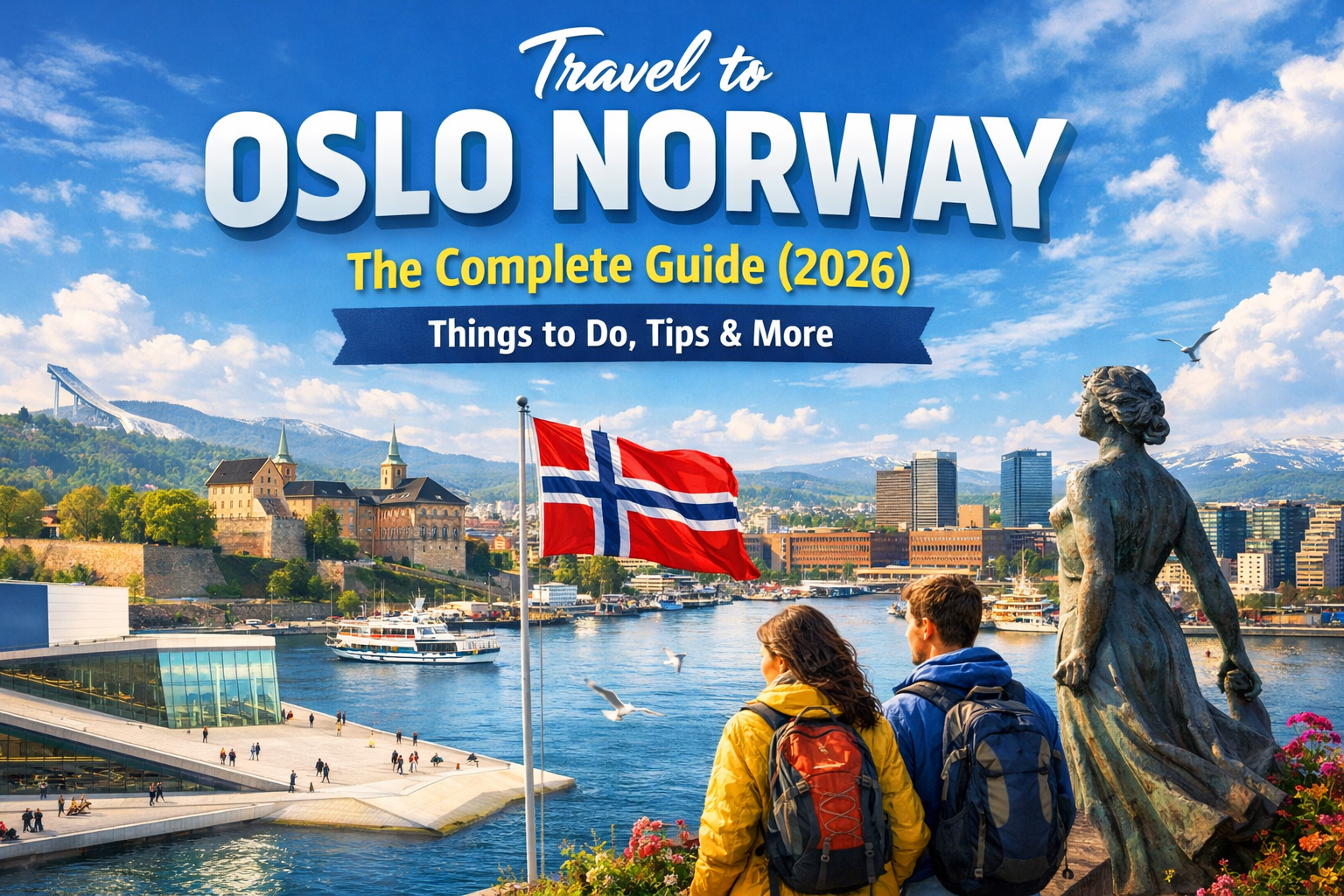
Travel to Oslo, Norway:
Everything You Need to Know
From Viking ships and fjord cruises to Michelin-starred restaurants and snow-lit Christmas markets — your complete 2026 guide to Norway’s stunning capital.
Oslo is one of Europe’s most underrated capitals. A city where Viking history and radical modern architecture coexist, where world-class museums sit minutes from a wild, forested wilderness, and where the fjord laps at the edge of the city centre. Here’s why it deserves a spot on your travel list:
Viking ships, Expressionist masterpieces, Nobel Peace history and polar expeditions — all within a compact city.
Island-hopping, kayaking, summer swimming and fjord cruises — all departing from the city waterfront.
Oslo is one of the world’s most forested capitals. Hiking and skiing start where the metro ends — 20 mins away.
New Nordic cuisine, Michelin-starred restaurants, and the best specialty coffee in Scandinavia.
Norway ranks among the world’s most peaceful countries. Ideal for solo travellers and families alike.
The Opera House, Munch Museum, and National Museum are among Europe’s most striking modern buildings.
Midnight sun, outdoor festivals, fjord swimming. Most expensive — book 2–3 months ahead. €180–280/night hotels.
Golden foliage, quiet streets, 20–30% cheaper hotels. Best balance of weather and cost for first-timers.
Christmas markets, skiing in Nordmarka, ice skating. Hotels 40–50% cheaper. Only 6–8 hrs of daylight.
Cherry blossoms, café terraces opening. Constitution Day (May 17) is Scandinavia’s biggest public celebration.
Norway is part of the Schengen Area. Entry requirements depend on your nationality.
- EU / EEA citizens — No visa required. No time limit on stay.
- USA, UK, Canada, Australia — Visa-free for up to 90 days within any 180-day period.
- 60+ other nationalities — Also enjoy visa-free access. Check the Norwegian UDI website for the full list.
- Passport validity — Must be valid at least 3 months beyond your departure date.
Oslo is served by Oslo Airport Gardermoen (OSL), ~47 km north of the city. Direct flights operate from North America, the Middle East, Asia, and across Europe (SAS, Norwegian Air, British Airways, Lufthansa, KLM and more).
| Transport Option | Journey Time | Price (approx.) | Best For |
|---|---|---|---|
| 🚄 Flytoget (Airport Express) | 19–22 min | ~230 NOK (€20) | Speed & comfort |
| 🚆 Vy Regional Train | 25–30 min | ~113 NOK (€10) | Budget travellers |
| 🚌 Flybussen (Airport Bus) | 40–50 min | 169–199 NOK | Luggage & groups |
| 🚕 Taxi / Ride-share | 30–50 min | 600–900 NOK | Late night only |
Oslo’s public transport — operated by Ruter — integrates metro (T-bane), trams, buses and ferries under one ticket. The Ruter app is the easiest way to buy tickets and plan routes.
| Ticket Type | Price (approx.) | What’s Included |
|---|---|---|
| Single Journey | ~40 NOK (€3.50) | Metro, tram, bus, ferry (1 zone) |
| 24-Hour Pass | ~160 NOK (€14) | Unlimited transport all day |
| Oslo Pass 24h | ~495 NOK (€44) | Transport + free museum entry |
| Oslo Pass 48h | ~745 NOK (€66) | Transport + free museum entry |
| City Bike Day Pass | ~59 NOK (€5) | Unlimited 45-min rides |
Norway’s most iconic modern building — walk directly onto its sloping marble roof for panoramic fjord views. One of Oslo’s best free experiences. Guided tours ~120 NOK.
The world’s largest sculpture park by a single artist — 200+ bronze and granite works including the iconic Monolith. Completely free, open year-round.
13-storey waterfront landmark housing 28,000+ works by Edvard Munch — including multiple versions of The Scream. Spectacular fjord views from upper floors.
The largest art museum in the Nordic countries (opened 2022). Permanent collection spans Norwegian and international art from antiquity to the present day.
A 700-year-old fortress overlooking Oslo Harbour. Free to enter. The Norwegian Resistance Museum inside is one of Europe’s finest WWII museums.
Dizzying observation platform with panoramic city and fjord views. The world’s oldest ski museum sits at its base. Zip line option for the adventurous.
Expanding into the world’s most significant Viking Age museum (fully opening 2027). Real 9th-century longships and exceptional Norse artefacts on display now.
Reinvented former shipyard — Oslo’s social heart in summer. Ferries depart for the fjord islands including Langøyene (summer swimming, picnicking).
| Neighbourhood | Character | Best For |
|---|---|---|
| Sentrum | Historic city centre, Karl Johans gate, Royal Palace | First-time visitors, shopping, cafés |
| Bjørvika | Newest cultural district, bold modern architecture | Opera House, Munch Museum, Deichman library |
| Grünerløkka | Oslo’s hippest area — coffee, vintage, street art | Brunch, craft beer, Saturday market |
| Bygdøy | The museum peninsula, accessible by ferry | Norwegian Folk Museum, Fram, Kon-Tiki |
| Frogner | Elegant, leafy, residential | Vigeland Park, boutiques, slow afternoons |
| Tjuvholmen | Luxury marina district | Astrup Fearnley Museum, waterfront dining |
Oslo’s food scene has undergone a dramatic transformation — it now belongs among Europe’s most exciting dining cities. New Nordic cuisine, world-class coffee, and excellent seafood define the experience.
Uniquely Norwegian brown cheese with a caramel-sweet flavour. A breakfast staple across Norway.
Fisketorget (Fish Market) near the waterfront — outstanding shrimp, salmon and crab at fair prices.
Heart-shaped, crispy, served with sour cream and strawberry jam. A national institution at every café.
Norwegian mulled wine at Christmas markets from late November. A winter Oslo essential.
Tim Wendelboe (Grünerløkka) is one of Scandinavia’s most influential roasters. Coffee culture is world-class here.
Three Michelin stars. Oslo’s most prestigious restaurant and the pinnacle of New Nordic gastronomy.
| Budget Level | Price/Night (approx.) | Options | Best Area |
|---|---|---|---|
| Budget | €40–70 | Hostels, dorm beds from 300–400 NOK | Grünerløkka, near Oslo S |
| Mid-Range | €130–220 | Scandic, Thon Hotels, Radisson | Sentrum, Bjørvika |
| Luxury | €250–500+ | Boutique waterfront & five-star hotels | Aker Brygge, Frogner |
| Destination | Distance / Time | Highlights |
|---|---|---|
| Drøbak | ~40 km · 1 hr by bus | Charming wooden town, Christmas House, seafood harbour, Oslofjord views |
| Oslofjord Islands | 20–40 min by ferry | Summer swimming, picnicking, kayaking, Langøyene nudist beach |
| Fredrikstad | ~90 km · 1.5 hr by train | Norway’s best-preserved fortress town, 17th-century old town (Gamlebyen) |
| Lillehammer | ~180 km · 2.5 hr by train | 1994 Winter Olympics site, Olympic Museum, bobsled run, ski jump |
| Bergen Railway | ~500 km · 7 hr by train | One of the world’s most scenic train journeys, Hardangervidda plateau |
| Expense | Budget | Mid-Range | Splurge |
|---|---|---|---|
| Accommodation/night | €40–70 (hostel) | €130–200 (3-star) | €250–450+ (luxury) |
| Lunch | €8–12 (bakery/kebab) | €18–28 (café) | €40–70 (restaurant) |
| Dinner | €15–20 (pizza/street food) | €35–60 (mid-range) | €100–250+ (fine dining) |
| Museum entry | €0 (Vigeland, Opera roof) | €12–20 per museum | €44 Oslo Pass 24h (unlimited) |
| Beer (bar) | — | €10–13 (120–150 NOK) | — |
| Coffee | €4–5 (filter) | €5–7 (espresso) | €8–12 (specialty) |
- Drink the tap water — Oslo’s tap water is excellent. Carry a reusable bottle and save on drinks all day.
- Shop at Rema 1000 or Kiwi — Oslo’s most affordable supermarket chains for self-catering.
- Eat lunch as your main meal — Dagsrett lunch specials are significantly cheaper than dinner menus.
- Use the Oslo Pass if visiting 3+ museums — the maths almost always works in your favour.
- Avoid taxis — Oslo taxis are among Europe’s most expensive. Use the T-bane or walk.
🌍 Ready to Plan Your Oslo Trip?
Book flights, accommodation, and the Oslo Pass in advance to get the best rates. Oslo is popular — especially in summer.
🗓 Information verified March 2026 — Always confirm visa requirements and attraction hours directly before travel.
Find More MSRTC Bus Timetables
Browse all Maharashtra ST bus routes, timetables and ticket prices