
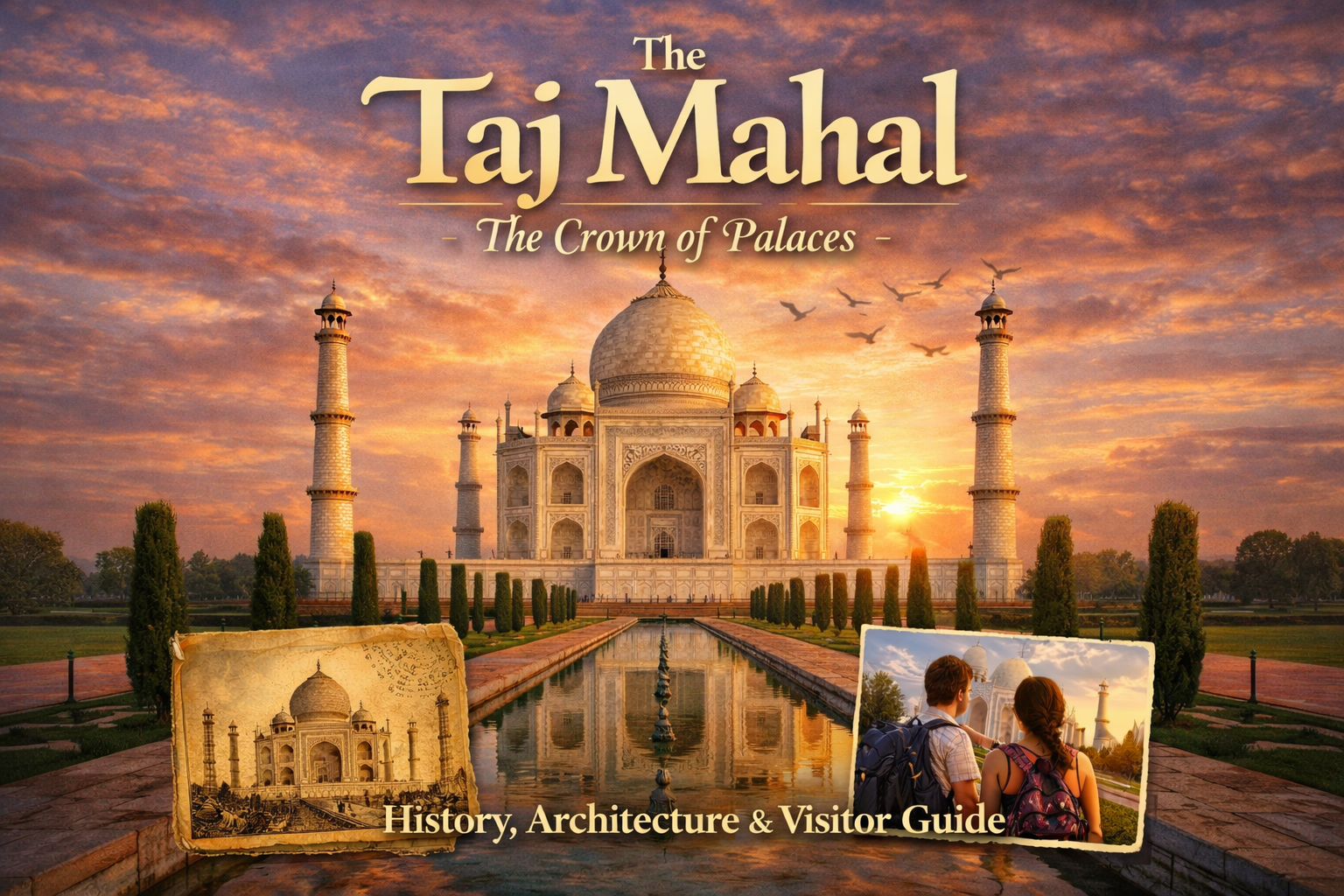
Taj Mahal Agra India — Complete Guide 2026
History | Architecture | Tickets | MSRTC Bus Guide
Everything about India’s most iconic monument — its history, who built it, stunning architecture, location in Agra, ticket prices ₹50–₹1,100, opening hours, and how to reach by MSRTC & state buses from Mumbai, Pune, Delhi, Jaipur and more.
📋 Table of Contents
- What is the Taj Mahal?
- History — Shah Jahan & Mumtaz Mahal
- Who Built the Taj Mahal & Why?
- When Was the Taj Mahal Built?
- Architecture of the Taj Mahal
- What’s Inside the Taj Mahal?
- Location — Where is the Taj Mahal?
- Taj Mahal Marble & Construction Materials
- Ticket Prices & Opening Hours 2026
- Tourism & Best Time to Visit
- Why is the Taj Mahal a Symbol of India?
- Taj Mahal Preservation & Conservation
- 25 Fascinating Taj Mahal Facts
- How to Reach by Bus — MSRTC & State Transport
- Nearby Attractions & Distances
- Frequently Asked Questions
The Taj Mahal — whose name translates from Persian as “Crown of Palaces” — is one of the most recognizable and beloved structures on Earth. It is an ivory-white marble mausoleum complex standing majestically on the southern bank of the Yamuna River in Agra, India. More than a tomb, it is a timeless poem carved in stone — an architectural testament to love, loss, and the extraordinary heights of human creativity.
Designated a UNESCO World Heritage Site in 1983, the Taj Mahal was described by the organization as “the jewel of Islamic art in India and one of the universally admired masterpieces of the world’s heritage.” In 2007, it was declared one of the New Seven Wonders of the World, cementing its place among the greatest monuments ever built by humankind.
The Taj Mahal is far more than its famous dome. It is an expansive 42-acre (17-hectare) complex that encompasses the central mausoleum, four towering minarets, a grand gateway (Darwaza-i Rauza), a reflective pool, symmetrical gardens, a mosque, a guesthouse (jawab), and subsidiary tombs. Every element was conceived as a unified whole — a vision of paradise made real.
Today, the Taj Mahal draws 7 to 8 million visitors every year, making it not only India’s most iconic monument but also its most commercially significant heritage site, earning ₹297 crore (approximately US$35 million) over five years according to a 2025 government report.
Quick Facts at a Glance
The Story of Shah Jahan and Mumtaz Mahal
The Taj Mahal was born from one of history’s great love stories. Arjumand Banu Begum, later known by her royal title Mumtaz Mahal (“Chosen One of the Palace”), was a Persian Muslim princess who married the Mughal prince Khurram — later Emperor Shah Jahan — in 1612. Their bond was extraordinary even by royal standards; Mumtaz accompanied Shah Jahan on military campaigns, was his most trusted companion, and held his heart entirely.
Tragedy struck on 17 June 1631, when Mumtaz Mahal died in Burhanpur during the birth of their fourteenth child, a daughter named Gauhar Ara. She was 38 years old. The Emperor was shattered. According to court historians, Shah Jahan emerged from eight days of seclusion with his hair turned white from grief. He reportedly refrained from music, celebrations, and the wearing of fine garments for two full years of mourning.
From that grief arose one of the greatest architectural undertakings in human history. Shah Jahan resolved to honour his beloved wife with a tomb unlike anything the world had ever seen — a monument that would stand forever as proof of his undying love.
The Vision Behind the Monument
Mumtaz Mahal was initially buried in Burhanpur, where she died, but her body was later transferred to Agra. The site chosen for the grand mausoleum was on the banks of the Yamuna River, where a mansion (haveli) belonging to Raja Jai Singh stood. Shah Jahan acquired the land in exchange for another estate in Agra, as documented in an imperial decree (firman). Construction of the Taj Mahal began in 1632.
The city of Agra was already a thriving Mughal capital. Akbar’s Fort had been rebuilt there, and the Yamuna riverfront was lined with the estates of nobles. The Taj Mahal was envisioned not merely as a burial site but as a complete “paradise garden” — a representation of the Islamic Jannah (paradise) on earth.
Decline and Colonial-Era Restoration
Following Shah Jahan’s death in 1666 — he was buried beside Mumtaz Mahal, the only asymmetrical element in the otherwise perfectly symmetrical complex — the Mughal Empire gradually declined. By the 18th century, the Taj Mahal suffered periods of neglect.
Lord Curzon, Viceroy of India from 1899 to 1905, initiated the first systematic restoration of the Taj Mahal after finding it in a state of disrepair — with damaged marble, overgrown gardens, and deteriorating inlaywork. His efforts established the principle of historical accuracy that guides conservation work to this day.
After Indian independence in 1947, the Archaeological Survey of India (ASI) assumed full responsibility for the monument’s maintenance, giving it the status of a Monument of National Importance and establishing dedicated professional conservation teams.
Construction Timeline
| Year | Milestone |
|---|---|
| 1631 | Mumtaz Mahal dies in Burhanpur. Shah Jahan begins planning the mausoleum. |
| 1632 | Construction officially begins in Agra. Land acquired from Raja Jai Singh. Foundation laid in red sandstone. |
| End of Year 1 | The grave chamber and surrounding walls took shape within the first year. |
| 1638–1639 | The central mausoleum (dome and main building) was substantially complete. |
| 1643 | Outlying buildings — mosque, jawab (guesthouse), main gateway — finished. |
| 1647–1653 | Detailed decorative work, calligraphy, and inlay completed. Full complex declared done. |
| 1658 | Shah Jahan deposed by son Aurangzeb and imprisoned in Agra Fort. |
| 1666 | Shah Jahan dies. Buried beside Mumtaz Mahal inside the Taj — the only asymmetry in the entire complex. |
| 1983 | Designated UNESCO World Heritage Site. |
| 2007 | Declared one of the New Seven Wonders of the World. |
💰 Total construction cost: ₹32 million in 1653 (≈ ₹52.8 billion / US$827 million in 2015 values). It nearly emptied the royal treasury.
The Taj Mahal was commissioned and built by Mughal Emperor Shah Jahan (born Prince Khurram, reigned 1628–1658) as an eternal tribute to his beloved wife Mumtaz Mahal, who died in childbirth in 1631. The emperor’s motivation was profound grief combined with a ruler’s determination to leave behind an immortal legacy of love.
The Architect: Ustad Ahmad Lahori
While Shah Jahan provided the vision and resources, the physical creation required extraordinary expertise. The chief architect of the Taj Mahal is widely credited as Ustad Ahmad Lahori, an Indian architect of Persian descent who served as the Emperor’s court architect. He led what contemporaries described as a “board of architects” — a multinational design team that included:
- Ismail Afandi (Ismail Khan) — Ottoman designer responsible for the iconic double dome
- Ustad Isa and Isa Muhammad Effendi — Persian architects who contributed to the overall design
- Puru — A Persian architect from Shiraz
- Amanat Khan Shirazi — The master calligrapher responsible for the stunning Quranic inscriptions
- A creative council of 37 specialists who formed the core advisory group
The workforce itself was enormous — more than 20,000 artisans, laborers, and craftsmen from India, Persia, Central Asia, and the Ottoman Empire worked on the project. Hundreds of elephants were used to transport materials. The royal coffers were reportedly nearly exhausted by the time the complex was complete.
Shah Jahan’s Own Fate
In a poignant twist of history, Shah Jahan himself never rested in the mausoleum in the way he intended. In 1658, his son Aurangzeb deposed him and placed him under house arrest in Agra Fort. For eight years, the aging Emperor gazed at his beloved creation from across the Yamuna River — tradition holds that he spent his final years staring at the Taj Mahal from the Musamman Burj tower of the fort. When he died in 1666, Aurangzeb buried him beside Mumtaz Mahal inside the Taj Mahal — the only deviation from the monument’s otherwise perfect symmetry, as Shah Jahan’s cenotaph is placed off-centre beside his wife’s.
Construction of the Taj Mahal began in 1632 AD (1041 AH in the Islamic calendar). The project unfolded in carefully sequenced phases over more than two decades. The mausoleum itself was complete by 1638–39, the surrounding buildings by 1643, and the full decorative programme by 1653 — 21 years of continuous construction.
The total cost at the time of completion was estimated at ₹32 million — a staggering sum equivalent to approximately ₹52.8 billion (US$827 million) in 2015 values. The financial strain was so severe that, as legend tells it, Shah Jahan’s treasury was left nearly empty after its completion.
The architecture of the Taj Mahal is widely regarded as the supreme achievement of Mughal architecture — a harmonious fusion of Indian, Persian, and Islamic design traditions that has never been equalled. It is simultaneously a monument of perfect mathematical proportion and of deeply felt human emotion.
Architectural Style: Indo-Islamic Perfection
The Taj Mahal belongs to the Indo-Islamic architectural tradition, which blends the structural language of Persian and Central Asian Islamic architecture with distinctly Indian sensibilities. Its design was inspired by earlier Mughal monuments, including:
- Gur-e-Amir, Samarkand — Timur’s tomb, which inspired the bulbous double dome
- Humayun’s Tomb, Delhi — The most direct predecessor, which introduced the charbagh garden layout and the hasht-behesht (eight-paradise) plan
- Itmad-ud-Daulah’s Tomb, Agra — The “baby Taj,” which pioneered white marble and pietra dura inlay at this scale
Yet the Taj Mahal surpassed all of its predecessors. As the UNESCO World Heritage Committee declared, it represents “the finest architectural and artistic achievement through perfect harmony and excellent craftsmanship in a whole range of Indo-Islamic sepulchral architecture.”
The Central Mausoleum
The main mausoleum sits on a raised plinth measuring 300 metres (980 ft) in length and 8.7 metres (28.5 ft) in height, with the structure set back to allow visitors a dramatic full view as they approach through the gateway and gardens.
Iconic onion dome topped by a gilded finial combining the Islamic crescent and Hindu kalasa motif — a synthesis of two civilizations in stone.
Deliberately tilted slightly outward so if they fall, they fall away from the mausoleum — an ingenious structural safety decision.
Quadripartite garden divided by water channels, symbolising the four rivers of Islamic paradise (Jannah).
Lapis lazuli, jade, turquoise, jasper, carnelian sourced from Afghanistan, China, Tibet and Arabia — inlaid directly into marble.
Pink at dawn, white in daylight, amber at dusk, silver under moonlight — the marble transforms with every hour of the day.
Letters grow larger at higher elevations to appear uniform in size when viewed from ground level — an extraordinary optical correction.
Symbolic Use of Colour: White Marble and Red Sandstone
One of the most visually powerful aspects of the Taj Mahal is its hierarchical use of materials. The mausoleum itself is constructed entirely of white marble. All surrounding structures (mosque, jawab, gateways, outer walls) are built in red sandstone.
This colour-coding carried profound symbolic meaning. The Mughals were drawing on an ancient Indian tradition from the Vishnudharmottara Purana, which associated white stone with the Brahmin priestly class and red stone with the Kshatriya warrior class. By employing both materials, the Mughal emperors positioned themselves as rulers within Indian cultural terms. Red sandstone also referenced the Persian imperial tradition of red as the exclusive colour of royal tents.
The Charbagh Garden — Paradise on Earth
The formal gardens of the Taj Mahal follow the Persian charbagh (four-garden) design — a quadripartite layout divided by walkways and water channels into four sections, symbolizing the four rivers of Islamic paradise. The design was introduced to India by Babur, the first Mughal Emperor.
One of the Taj’s unique design innovations is that the tomb is placed at the end of the garden rather than at its centre — a departure that adds dramatic visual depth and perspective, drawing the eye toward the mausoleum as the culminating focal point. The reflecting pool along the central axis of the garden creates the famous doubled image that appears in countless photographs worldwide.
Decorative Programme: Inlay, Calligraphy, and Geometry
Every surface of the Taj Mahal is covered in decoration of breathtaking refinement. The main techniques are:
- Pietra Dura (Parchin Kari): The art of inlaying semi-precious stones directly into the marble surface to create elaborate floral, arabesque, and geometric patterns. Stones include lapis lazuli, jade, turquoise, jasper, carnelian, coral, onyx, and mother-of-pearl.
- Calligraphy: Verses from the Quran, executed by master calligrapher Amanat Khan Shirazi, appear on the main gateway and around the arched iwans. The script grows progressively larger at higher elevations to create the optical illusion of uniform size from the ground.
- Jali (Lattice Screen): Finely carved white marble screens with geometric patterns surround the cenotaphs inside the chamber, allowing light to filter through in shifting, lace-like patterns throughout the day.
- Floral Relief Carving: The white marble facades are carved with naturalistic floral motifs — lilies, tulips, irises, daffodils — reflecting both Mughal botanical interest and the ancient Indian tradition of the “vase of plenty.”
The Play of Light — Why the Taj Mahal Looks Different Every Hour
Perhaps the Taj Mahal’s most astonishing architectural quality is how it transforms with light. The white Makrana marble is highly reflective and translucent, allowing it to absorb and re-emit colour from its surroundings:
- At Dawn: Soft pink and golden hues as the rising sun touches the marble
- In Daylight: Brilliant, almost blinding milky white
- At Dusk: Warm amber and orange tones
- Under Moonlight: A ghostly, ethereal silver-white glow
This quality was no accident — Shah Jahan’s architects deliberately selected Makrana marble for its unique optical properties. The interplay of light and shadow across the carved surfaces, the dome, and the minarets ensures that the Taj Mahal appears different — and equally breathtaking — at every hour of the day. This is the reason sunrise and moonlit nights are the most prized visiting times.
The interior of the Taj Mahal is as refined as its exterior. Entering through the arched portal of the mausoleum, visitors find themselves in the central octagonal burial chamber, where the cenotaphs of Mumtaz Mahal and Shah Jahan are displayed.
| Structure | Description |
|---|---|
| Cenotaph of Mumtaz Mahal | Placed in perfect geometric centre of the burial chamber, on a raised rectangular platform decorated with inlaid floral plant motifs. |
| Cenotaph of Shah Jahan | Installed more than 30 years after Mumtaz’s. Placed beside hers on its western side. Slightly larger — the only asymmetrical element in the entire complex. |
| Real Graves (Crypt) | The upper cenotaphs are symbolic. The actual graves are in a lower tomb chamber (crypt) directly beneath, following the imperial Mughal tradition of double-level burial. |
| Jali Screen | An exquisitely carved octagonal marble lattice screen, originally in gold but replaced in marble, surrounds the cenotaphs. Its delicate geometric patterns filter natural light into shifting lace-like patterns throughout the day. |
| Wall Decorations | The walls are inlaid with precious stones arranged into flowers and plants with astonishing naturalism. The borders of the frames are executed with near-perfect precision. |
Other Structures in the Complex
- Darwaza-i Rauza (Main Gateway): The dramatic entry arch in red sandstone and white marble, covered in Quranic calligraphy. It frames your first view of the mausoleum perfectly — the reason the Taj Mahal appears to “reveal itself” as you approach.
- Mosque (Masjid): To the west of the mausoleum, built in red sandstone. It is a functioning mosque and was built to provide a place of worship for the Taj complex.
- Jawab (Guesthouse): An identical building to the east of the mausoleum, placed purely for symmetry — it mirrors the mosque exactly but is not used for prayer.
- Hauz-i-Kausar (Lotus Pool): The large ornamental tank at the midpoint of the garden, whose still surface reflects the entire mausoleum — creating the most photographed view of the Taj Mahal.
- Mahtab Bagh (Moonlight Garden): A garden on the opposite (northern) bank of the Yamuna River, archaeologically established by the ASI as part of the original Taj complex. It offers a stunning across-river view and supports the hypothesis that the Yamuna River itself was incorporated into the garden’s paradise design as one of the “rivers of paradise.”
The Taj Mahal is located in Agra, Uttar Pradesh, India — specifically in the Tajganj neighbourhood, on the southern bank of the Yamuna River. Its precise geographical coordinates are 27.1751° N, 78.0421° E.
- From Delhi: Approximately 233 km (3–4 hours by road via Yamuna Expressway). The Gatimaan Express train runs Delhi–Agra in under 2 hours.
- From Delhi by Train: Agra Cantt railway station is about 6 km from the Taj Mahal.
- By Air: Pandit Deen Dayal Upadhyay Airport (AGR) in Agra has limited flights. Delhi’s Indira Gandhi International Airport (DEL) is the nearest major hub.
- Within Agra: Taxis, auto-rickshaws, e-rickshaws, and battery-operated buses are available from the Taj complex parking areas to the entry gates. No personal vehicles beyond a certain point to reduce pollution near the monument.
- Entry Gates: Western Gate (most popular, widest footfall), Eastern Gate, and Southern Gate (exit only).
Agra is located in western Uttar Pradesh state, in the Braj cultural region. Once the capital of the Mughal Empire, the city is home to three UNESCO World Heritage Sites: the Taj Mahal, Agra Fort, and Fatehpur Sikri. The Agra Fort — another magnificent Mughal monument — stands approximately 1.6 km west of the Taj Mahal along the same Yamuna riverfront.
Agra is part of India’s famous Golden Triangle tourist circuit, connecting Delhi, Agra, and Jaipur — three cities that together offer an unparalleled window into Mughal and Rajput history. The Taj Mahal stands as the crown jewel of this circuit.
The most defining material of the Taj Mahal is its white Makrana marble — a highly pure, translucent marble quarried from Makrana, Rajasthan, approximately 400 km from Agra. This marble has exceptional optical properties: it absorbs and re-emits light, giving the Taj Mahal its characteristic glow that changes colour throughout the day.
Makrana marble is still quarried today and used for restoration work on the monument, maintaining the principle of original-material authenticity in conservation.
Taj Mahal Quartzite Foundations
Beneath the marble grandeur, the Taj Mahal rests on a foundation of quartzite — a hard, dense, non-porous stone that provides stability on the alluvial soil of the Yamuna riverbank. The entire complex sits on a platform built with alternating patterns of dark and light-coloured sandstone. This quartzite foundation system relies on constant moisture from the Yamuna River to remain stable — a critical reason why the ongoing drying of the Yamuna River is one of the most serious long-term preservation threats the monument faces today.
Semi-Precious Stones Used in Inlay
The pietra dura inlay work on the Taj Mahal incorporates an astonishing variety of gemstones and minerals sourced from across Asia:
- Lapis Lazuli — from Afghanistan (deep blue)
- Jade — from China (green)
- Turquoise — from Tibet and Iran (sky blue)
- Jasper — from Punjab (red/yellow)
- Carnelian — from Arabia (orange-red)
- Onyx, coral, mother-of-pearl — from various sources
- Crystal — for clarity in floral detailing
Hundreds of elephants were used to transport materials from across the empire and beyond. The construction was, in a very real sense, a global undertaking — one of the most internationally collaborative architectural projects of the 17th century.
⏰ Official Opening Hours
| Detail | Information |
|---|---|
| Open Days | Every day except Friday |
| Opening Time | 30 minutes before local sunrise (~6:00 AM) |
| Closing Time | 30 minutes before local sunset (~6:30 PM) |
| Ticket Windows | 1 hour before sunrise to 45 minutes before sunset |
| Closed On | Every Friday (mosque prayer day) |
| Friday Exception | Open in the afternoon for Muslims attending prayers at the mosque |
🌙 Night Viewing Schedule
| Detail | Information |
|---|---|
| Available On | Full moon night + 2 nights before + 2 nights after (5 nights per month) |
| Timing | 8:30 PM to 12:30 AM | 8 batches of 50 visitors | 30 minutes per batch |
| Closed For Night Viewing | Every Friday and the entire month of Ramadan |
| Booking | Must be booked 24 hours in advance at the official counter |
| Security Check | Report to Shilpgram (near Eastern Gate) 30 min before your slot |
| Tip | Bring your passport for verification. Arrive early — no admission after your slot time. |
💰 Taj Mahal Ticket Prices 2026
| Visitor Category | Complex Entry | + Main Mausoleum | Total |
|---|---|---|---|
| 🇮🇳 Indian Citizens / OCI | ₹50 | ₹200 (optional) | ₹50 – ₹250 |
| 🌏 SAARC / BIMSTEC Countries | ₹540 | ₹200 (optional) | ₹540 – ₹740 |
| 🌍 Foreign Tourists | ₹1,100 | ₹200 (optional) | ₹1,100 – ₹1,300 |
| 👶 Children under 15 | FREE | FREE | No charge |
| 🌙 Night Viewing | ~₹810 (foreign) / ₹510 (SAARC) / ₹50 (Indian) | Book separately | |
✅ What You Can & Cannot Bring
Personal photography (phone/camera), water bottles and light snacks, government-issued ID (required for entry)
Drone cameras (strictly banned), tripods inside the mausoleum, food inside the main complex, plastic bags, tobacco and alcohol
🕐 Ticket prices verified April 2026 — Please check asi.payumoney.com or asiagracircle.in for any latest changes before your visit.
The Taj Mahal is India’s single most visited monument and one of the most-visited tourist sites in the world, attracting 7 to 8 million visitors annually. Since 2019, daily visitor numbers have been capped at 40,000 people per day to prevent overcrowding damage to the monument, and visitors who stay longer than three hours face fines.
Best Season to Visit
| Season | Months | Conditions | Recommendation |
|---|---|---|---|
| 🌟 Peak / Best | October – March | Cool, clear skies (10–25°C) | Ideal — best for photography and comfort |
| ☀️ Hot Summer | April – June | Very hot (30–45°C) | Visit at sunrise only; midday is brutal |
| 🌧️ Monsoon | July – September | Humid, occasional rain | Fewer crowds; lush green gardens; misty views |
Best Time of Day to Visit
- Sunrise (Opening Time): The single best time — soft golden light, smaller crowds, and the most photographically magical conditions. Gates open 30 minutes before sunrise.
- Late Afternoon (3–5 PM): Second-best for photography as the sun begins to warm the marble with amber tones.
- Full Moon Night: Unmissable if your travel dates align — the white marble glowing under moonlight is an extraordinary sight that very few monuments in the world can match.
- Avoid 10 AM – 2 PM: Busiest crowd period, harsh overhead light, and the longest queue times.
Hotels Near the Taj Mahal
Agra offers accommodation options across all budgets, from luxury five-star properties with Taj Mahal views to comfortable budget hotels in the Tajganj area. Some of the most iconic hotels near the Taj Mahal include the Oberoi Amarvilas (world-famous for its direct Taj Mahal views from every room), ITC Mughal, Trident Agra, and The Gateway Hotel Agra. Budget travellers have a wide choice of guesthouses and hostels in the Tajganj neighbourhood, within walking distance of the gates.
The Taj Mahal is far more than an architectural achievement — it is the defining symbol of India’s identity on the world stage. It appears on Indian currency, in every tourism campaign, in the imagination of billions of people worldwide, and as the single most recognizable image associated with the country.
Its symbolic power operates on multiple levels:
- Symbol of Love: The Taj Mahal is universally understood as the world’s greatest monument to romantic love. Every couple who visits reenacts, in some small way, the devotion that created it.
- Symbol of Cultural Synthesis: The monument embodies the meeting of Persian, Islamic, Central Asian, Ottoman, and Indian artistic traditions — a living proof that India’s greatest achievements have always been born from the confluence of cultures.
- Symbol of Artistic Mastery: No building has ever combined scale, symmetry, material refinement, and decorative detail quite like the Taj Mahal. It remains the standard against which all Mughal-era art is measured.
- Symbol of National Pride: For 1.4 billion Indians, the Taj Mahal is proof of the extraordinary heights their civilization has reached — a source of enduring pride across religions, regions, and generations.
- Symbol of Heritage Tourism: As India’s top international tourist destination, the Taj Mahal drives billions of dollars in economic activity and positions India as a must-visit destination in global travel consciousness.
The Taj Mahal’s preservation is one of the world’s most comprehensive and challenging heritage conservation efforts. The monument faces threats from multiple directions — and India has responded with increasingly sophisticated scientific and legal interventions.
Modern Threats
- Air Pollution: Industrial emissions, vehicle exhaust, and Mathura refinery pollution have caused the white marble to yellow and deteriorate over decades. Sulphur dioxide reacts with the marble to form calcium sulphate (gypsum), causing a process known as “marble cancer.”
- The Yamuna River’s Decline: The drying of the Yamuna River — its flow dramatically reduced by upstream dams and diversions — threatens the wooden well-foundation system on which the monument rests. The original builders sank hundreds of timber wells into the riverbank, relying on constant water saturation to keep the wood from rotting. A drier Yamuna endangers this ancient foundation system.
- Insect Damage: Khejra flies breeding in the polluted Yamuna leave green-black deposits on the marble surfaces.
- Overtourism: Eight million annual visitors generate significant wear; the daily cap of 40,000 was introduced to manage this pressure.
- Climate Change: Rising temperatures, changed rainfall patterns, and extreme weather events create new deterioration challenges beyond the monument’s historical experience.
Conservation Efforts
- A Trapezium Zone of 10,400 sq km around the Taj restricts all industrial activity
- The Supreme Court has mandated strict environmental controls since 1993
- A ₹500 crore restoration project (2018–2025) included marble cleaning using multani mitti (Fuller’s Earth) clay packs, structural repairs, and garden restoration
- An air quality monitoring station provides continuous atmospheric data around the monument
- Specialized ASI conservation teams use traditional pietra dura and marble-carving skills to repair damage, passing these skills to new generations
- Battery-operated vehicles replace petrol vehicles near the monument to reduce exhaust damage
The ASI oversees daily maintenance with specialized conservation teams, ensuring that the skills of traditional Mughal craftsmanship — pietra dura inlay, marble carving, calligraphic restoration — are maintained and passed to new generations of artisans.
| # | Fact |
|---|---|
| 1 | “Taj Mahal” is Urdu/Persian for “Crown of Palaces.” |
| 2 | Construction employed over 20,000 artisans from India, Persia, Central Asia, and the Ottoman Empire. |
| 3 | The four minarets are deliberately tilted slightly outward to protect the mausoleum if they fall. |
| 4 | The marble changes colour — pink at dawn, white in daylight, golden at dusk, silver under moonlight. |
| 5 | Calligraphy letters near the top are written proportionally larger to appear uniform in size from ground level. |
| 6 | Shah Jahan’s cenotaph is the only asymmetrical element in the entire complex — added later by his son Aurangzeb. |
| 7 | Total cost: ₹32 million in 1653 (≈ ₹52.8 billion / US$827 million in 2015 values). It nearly emptied the royal treasury. |
| 8 | Hundreds of elephants transported building materials to the construction site. |
| 9 | White marble came from Makrana, Rajasthan — the same quarry that supplies restoration marble today. |
| 10 | Semi-precious stones for inlay were sourced from Afghanistan, China, Sri Lanka, Tibet, and Arabia. |
| 11 | The Taj Mahal was designated a UNESCO World Heritage Site in 1983. |
| 12 | Declared one of the New Seven Wonders of the World in 2007 via global public vote. |
| 13 | Mumtaz Mahal was Shah Jahan’s third wife — but the one he loved most deeply. |
| 14 | She died giving birth to their 14th child, Gauhar Ara, on 17 June 1631. |
| 15 | Shah Jahan was imprisoned by his son Aurangzeb and spent his final 8 years gazing at the Taj from Agra Fort. |
| 16 | The Mahtab Bagh (Moonlight Garden) across the Yamuna was part of the original design — the river itself was incorporated as a “river of paradise.” |
| 17 | During World War II, the monument was camouflaged with bamboo scaffolding to protect it from potential aerial bombing. |
| 18 | During the 1971 India–Pakistan war, the government camouflaged it again with scaffolding. |
| 19 | The Taj Mahal earns more revenue than any other ASI monument — ₹297 crore over five years per a 2025 government report. |
| 20 | The fountain jets fill from underground tanks — rising synchronously with no pump pipes visible above ground. |
| 21 | The dome finial combines the Islamic crescent moon with the Hindu kalasa (pitcher) symbol — a profound cultural synthesis. |
| 22 | There is no electricity inside the mausoleum — light enters only through carved marble lattice screens (jali). |
| 23 | The complex covers 42 acres in total, including gardens, gateway, mosque, and subsidiary tombs. |
| 24 | Daily visitor numbers are capped at 40,000 per day to prevent overcrowding damage to the monument. |
| 25 | 7–8 million people visit annually, making it one of the most visited monuments on Earth. |
Visiting the Taj Mahal by state or private bus is one of the most affordable and practical options for travellers from across India. MSRTC (Maharashtra State Road Transport Corporation) connects Maharashtra cities via routes toward Agra, while UPSRTC, RSRTC, and private operators run direct buses into Agra. Here is a complete city-by-city guide with timings, fares, and suggested Taj Mahal visit schedules.
🚌 Delhi → Agra — Detailed Bus Timetable
Delhi is the closest major metro to Agra, making it the most popular bus route for Taj Mahal visitors. With over 728 daily bus services operated by 158+ operators including UPSRTC and private lines, there is a bus at virtually every hour of the day and night.
| Departure | Bus Type | Operator | Boarding Point | Arrival Agra | Fare |
|---|---|---|---|---|---|
| 5:15 AM | AC Seater (Volvo) | Private | Karol Bagh | ~10:00 AM | ₹400–₹800 |
| 6:00 AM | Non-AC Seater | UPSRTC / Private | ISBT Kashmiri Gate | ~10:00 AM | ₹199–₹350 |
| 7:30 AM | Non-AC Seater | UPSRTC (First UPSRTC) | ISBT Kashmiri Gate | ~11:00 AM | ₹200–₹300 |
| 9:00 AM | AC Semi-Sleeper | NueGo / Private | Akshardham Metro Stn. | ~1:00 PM | ₹500–₹900 |
| 12:00 PM | Non-AC / AC Seater | Multiple operators | Anand Vihar / ISBT | ~4:00 PM | ₹250–₹600 |
| 9:30 PM | Non-AC Seater | UPSRTC (Last UPSRTC) | ISBT Kashmiri Gate | ~1:00 AM | ₹200–₹300 |
| 11:00 PM | Volvo AC Sleeper | Private | Dhaula Kuan / Dwarka | ~3:00 AM | ₹700–₹1,500 |
🚌 Mumbai → Agra — Overnight Bus Timetable (MSRTC & Private)
Mumbai to Agra covers approximately 1,300–1,400 km. MSRTC does not run a dedicated direct Mumbai–Agra service; the best approach is private overnight sleeper buses, or MSRTC to Indore then onward connection. Direct journey takes approximately 25–42 hours.
| Departure | Bus Type | Operator | Boarding (Mumbai) | Arrival Agra | Fare |
|---|---|---|---|---|---|
| 5:30 PM | AC Sleeper (Scania/Volvo) | Deccan Tours & Travels | Andheri East / Borivali | Next day ~7 PM | ₹2,500–₹3,200 |
| 6:00 PM | AC Sleeper | Hans Travels Pvt. Ltd. | Bandra East / Ghatkopar | Next day ~8 PM | ₹2,100–₹2,800 |
| 7:00 PM | Volvo Multi-Axle Sleeper | Safar Express | Dadar / Kalyan | Next day ~7:30 PM | ₹2,300–₹4,999 |
🚌 Pune → Agra Bus Guide (MSRTC Connecting Route)
Pune is one of Maharashtra’s largest cities and a major MSRTC hub. While MSRTC does not run a direct Pune–Agra service, a well-planned connecting journey via Indore or Nagpur works effectively. The Pune → Mumbai → Agra route is often the most practical option.
| Route | Departure | Bus Type | Duration | Fare |
|---|---|---|---|---|
| Pune → Indore (direct) | 6:00–9:00 PM | MSRTC Shivshahi AC / Private Sleeper | ~13–15 hrs | ₹700–₹1,800 |
| Indore → Agra (connect) | Morning / Evening | MPSRTC / Private AC | ~7–8 hrs | ₹400–₹900 |
| Pune → Agra (Private Direct) | 5:00–7:00 PM | AC Sleeper (Private) | ~26–30 hrs | ₹2,000–₹3,500 |
| Pune → Delhi (MSRTC long route) | Check MSRTC portal | Ashwamedh / Shivshahi | ~24–26 hrs | ₹1,500–₹2,500 |
🚌 Nagpur → Agra Bus Guide
Nagpur, located at the geographic centre of India, has good bus connectivity toward Agra via Jhansi or Gwalior. MSRTC operates services from Nagpur to major north Indian junctions, and private operators run overnight sleeper buses on this route.
| Departure | Bus Type | Via | Travel Time | Fare |
|---|---|---|---|---|
| 5:00–7:00 PM | AC Sleeper / Volvo | Jhansi → Gwalior → Agra | ~16–18 hrs | ₹1,200–₹2,500 |
| 8:00–9:00 PM | Non-AC Sleeper | Jhansi → Agra | ~18–20 hrs | ₹800–₹1,400 |
| MSRTC Nagpur → Jhansi | Check MSRTC portal | Jhansi (connect to Agra) | ~12 hrs + 3 hrs connect | ₹600–₹1,000 + ₹150–₹300 |
🚌 Jaipur → Agra Bus Guide (RSRTC & UPSRTC)
Jaipur is the closest major metro to Agra (just ~222 km) and is part of the famous Golden Triangle circuit. RSRTC and UPSRTC both operate regular services on this route. With over 239+ daily services, it is one of the best-connected inter-city bus routes in North India for Taj Mahal visitors.
| Departure | Bus Type | Operator | Boarding (Jaipur) | Arrival Agra | Fare |
|---|---|---|---|---|---|
| 4:02 AM (First UPSRTC) | Non-AC Seater | UPSRTC | Sindhi Camp / Narayan Singh Circle | ~9:00 AM | ₹200–₹350 |
| 5:00–7:00 AM | AC Seater / Volvo | RSRTC / Private | Sindhi Camp Bus Stand | ~10:00 AM | ₹300–₹700 |
| 10:00 AM–12:00 PM | UPSRTC Janrath AC | UPSRTC | Ajmer Road / Transport Nagar | ~3:00 PM | ₹515 |
| 7:20 PM (Last UPSRTC) | AC Seater / Volvo | UPSRTC | Sindhi Camp | ~12:00 AM | ₹350–₹700 |
| 11:59 PM (Last Bus) | Volvo Multi-Axle AC Sleeper | Private | Sindhi Camp | ~4:00 AM | ₹500–₹10,000 |
🚌 Hyderabad → Agra Bus Guide
Hyderabad to Agra is approximately 1,500 km. Direct private sleeper buses exist, but most travellers from Hyderabad prefer the train for this distance. For those committed to the bus:
| Route Option | Departure | Bus Type | Duration | Fare |
|---|---|---|---|---|
| Direct Private Sleeper (Hyd → Agra) | 5:00–7:00 PM | AC Sleeper / Volvo | ~24–28 hrs | ₹2,000–₹4,000 |
| TSRTC Hyd → Nagpur + connect | Morning / Evening | TSRTC AC / Volvo | ~12 hrs + 18 hrs | ₹800 + ₹1,200 |
| Hyd → Delhi (overnight) + Delhi → Agra | 5:00–6:30 PM | Private AC Sleeper | ~28 hrs + 4 hrs | ₹2,500 + ₹300 |
🗓️ Suggested Taj Mahal Visit Schedules from Metro Cities
| City | Depart | Arrive Agra | Taj Mahal Visit | Return Bus | Back Home |
|---|---|---|---|---|---|
| Delhi | 5:30–6:30 AM | ~9:30–10:30 AM | 10:30 AM – 2:00 PM (+ Agra Fort 2–4 PM) | 5:00–6:00 PM | ~9:00–10:00 PM |
| Jaipur | 5:00–6:00 AM | ~10:00–11:00 AM | 11:00 AM – 3:00 PM (Taj + surroundings) | 4:00–5:00 PM | ~9:00–10:00 PM |
| Mumbai | Day 1: 6:00 PM (overnight) | Day 2: 7:00–9:00 PM | Day 3: Sunrise 6:30 AM | Day 3: 7:00 PM overnight | Day 4 Morning |
| Pune | Day 1: 7:00 PM (overnight) | Day 2: Evening (via connect) | Day 3: Sunrise + morning visit | Day 3: Evening | Day 4–5 Morning |
| Nagpur | Day 1: 6:00 PM overnight | Day 2: 10:00 AM–12 PM | Day 2: Morning + afternoon | Day 2: 6:00 PM bus | Day 3 Morning |
| Hyderabad | Day 1: 6:00 PM overnight | Day 2: 6:00–8:00 PM | Day 3: Full day visit | Day 3: Night bus | Day 4–5 Morning |
📱 How to Book MSRTC / State Bus Tickets Online
- MSRTC (Maharashtra): msrtc.maharashtra.gov.in | App: MSRTC | Helpline: 1800-22-1250
- UPSRTC (Uttar Pradesh): upsrtc.com
- RSRTC (Rajasthan): rsrtc.rajasthan.gov.in
- TSRTC (Telangana): tsrtconline.in
- Multi-operator Aggregators: RedBus (redbus.in) | AbhiBus (abhibus.com) | MakeMyTrip | Goibibo
- MSRTC Bus Types Available: Sadi (Ordinary), Asiad/Hirakni, Shivshahi AC, Ashwamedh, Shivneri (Volvo AC)
🚌 Bus timings verified April 2026 — Always confirm at the official operator website before travel. Fares may vary by season and demand.
🎟️ Book Taj Mahal Tickets & MSRTC Bus Online
Book your ASI entry ticket online and skip the queue at the gate. Also explore MSRTC bus timetables for your journey from Maharashtra to Agra!
Find More MSRTC Bus Timetables
Browse all Maharashtra ST bus routes, timetables and ticket prices